
Gin Rummy Extra - Online Rummy
Bro3 GamesCard
4.53.76K Reviews
- Version
- 4.02.5
- Installs
- 1.00M
- Age Rating
- Teen
Screenshots



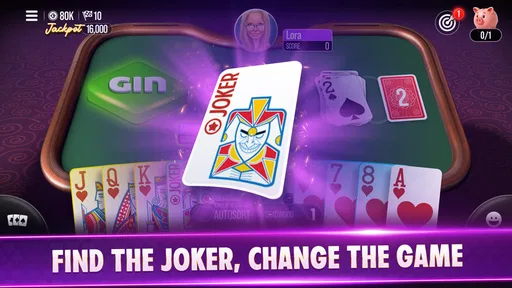

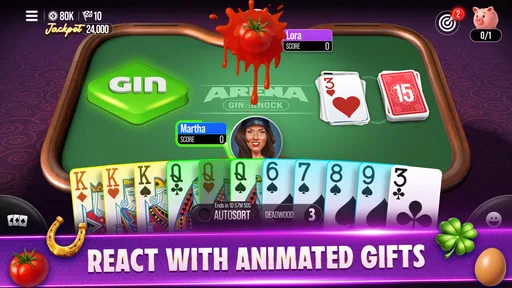
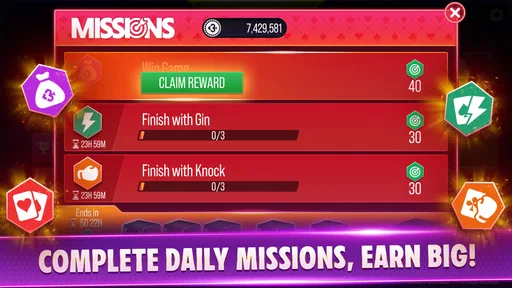

Our Review of Gin Rummy Extra - Online Rummy
 Analysis by Appyee
I spent time with Gin Rummy Extra - Online Rummy as a casual card game and found that its appeal is less about flashy presentation and more about having a quick place to play Gin Rummy against other people. It is a free multiplayer card game from Bro3 Games, aimed at players who already know the basic rules or are willing to learn them through practice. The central loop is familiar: draw, discard, build melds, and try to finish with less deadwood than your opponent.
That simplicity makes it easy to start, but it also means the quality of each session depends heavily on how thoughtfully you play. I would not describe it as a passive time-killer where you can make random moves and still have a satisfying experience. The better results came when I treated each hand as a small information puzzle, watched what the other player discarded, and avoided chasing every possible combination. The strongest reason to try it is the short, repeatable rhythm of online Gin Rummy, not a large collection of unrelated modes.
How the everyday playing experience comes together
The basic workflow is straightforward. I open a match, look at the cards in my hand, decide whether the visible discard is useful, and then choose which card to release. Each turn asks for a small decision, but the consequences build quickly. Holding a card because it might complete a run can be sensible early in a hand; holding it too long can become a liability once the opponent has shown interest in a nearby rank or suit.
This is where the game works well for a short break. A hand gives me something concrete to focus on without demanding the long preparation of a strategy game. I can play with a relaxed approach when I only want a few minutes of card play, or I can slow down and calculate more carefully when I want to improve. The same rules support both moods, although the online setting naturally makes mistakes feel more immediate than they would in a solo practice game.
New players should learn the difference between making a visible meld and keeping a flexible hand. A pair can become useful, but it can also tempt you to hold two cards that never connect. Likewise, a sequence with one missing card looks promising while it is still possible, yet the missing card may already be in the opponent’s hand or buried in the stock. I found that separating “possible” combinations from “likely” combinations made my decisions more consistent.
The discard pile is the most important source of information during normal play. If the other player repeatedly ignores cards that would fit a certain pattern, that may tell you something about the shape of their hand. It is not proof, because a player can deliberately avoid revealing a plan, but it is still more useful than looking only at your own cards. I recommend making a quick mental note of the ranks and suits that have already been rejected instead of reacting to each discard in isolation.
One practical habit helped me avoid many unnecessary losses: before discarding, I checked the card I was giving away against both of my likely plans. If it completed a run in one imagined line but left my hand with several unrelated cards, I usually preferred to keep the more flexible structure. This sounds basic, yet it prevents the common mistake of protecting a pretty-looking combination while quietly accumulating deadwood elsewhere.
The game is also a reasonable choice for people who want online competition without learning a new rule set. If you have played physical Gin Rummy, the transition is natural. If you normally play simpler matching games, the first sessions may feel more demanding because every discard carries information. I would start by focusing on clean decisions rather than trying to win quickly. Speed comes later, after the card relationships become easier to recognize.
Settings and routines that deserve attention
I recommend checking the available in-game settings before settling into regular matches. The useful principle is simple: make the interface comfortable enough that you can concentrate on the cards rather than fighting the controls. Look for options that affect sound, notifications, or the general way the game behaves on your device, and adjust them to match the situation. I prefer a quieter setup when playing in public and a more noticeable audio setup when I am at home and want clearer feedback.
Notifications are worth treating carefully. A competitive card game is easier to enjoy when it fits around your day instead of interrupting it. If the device offers notification controls for the game, I would keep only the alerts that help me return to something I intentionally started. I would avoid allowing every possible prompt to compete with work, study, or conversation. This is not a gameplay advantage, but it makes the overall experience less distracting.
Because the game is rated Teen, I would also consider the environment in which it is being used. Online play can bring interaction with people you do not know, so younger players should use the device’s broader family and account controls where appropriate. I would not treat the age label as a reason to avoid the game automatically, but I would take it seriously when deciding whether it suits a particular player.
The free entry point is convenient, especially for someone comparing several card games. At the same time, in-app purchases range from less than a dollar to nearly two hundred dollars per item, so I would review spending controls before handing the device to a child or leaving purchases unrestricted. I did not need to spend money to understand the core card-play appeal. For me, the sensible approach is to try the free experience first and decide later whether any optional purchase genuinely improves the way you play.
Another useful routine is to play with a stable connection and enough battery rather than starting a match in the middle of a rushed commute. Online card games are not physically demanding, but an interrupted turn can still ruin a carefully planned hand. If I know I have only a moment, I would choose a different activity instead of entering a match and then abandoning it. That small bit of planning improves the experience for both players.
The current version is 4.02.5, and the game runs on Android 7.0 or later. That makes it accessible on many older Android devices, although actual comfort will still depend on the phone’s condition, screen size, and connection. On a smaller display, I would take an extra second to confirm the selected card before submitting a move. A deliberate tap is safer than trying to play at maximum speed and accidentally discarding something valuable.
Faster decisions without throwing away good cards
Experienced play is not simply about moving quickly. It is about reducing the number of decisions you need to reconsider. I found it helpful to sort my thinking into three groups: cards already close to a meld, cards that are flexible because they can connect in more than one direction, and cards that are isolated. When the turn arrives, I first check whether the new card changes one of those groups. If it does not, the isolated card is often the most logical discard.
That method is faster than repeatedly rebuilding the entire hand in my head. It also limits emotional decisions. A high card can feel attractive because it might become part of a set, but if it has no supporting structure after several turns, it is usually safer to release it. The exact choice still depends on the opponent’s behavior and the remaining possibilities, yet a clear default prevents me from holding every card “just in case.”
Another repeatable pattern is to protect flexibility early and become more selective later. At the beginning of a hand, I prefer combinations that can develop in multiple ways. As more cards appear in the discard pile, I narrow my plan and stop treating every theoretical completion as equally realistic. This shift is important because the value of a card changes during the hand. A card with several possible connections early on may become a poor hold once the relevant neighbors have already been discarded.
I also avoid copying the opponent’s last move too literally. If they take a discard, that tells me the card has some value to them, but it does not reveal the full combination they are building. Taking every nearby card away from them can leave my own hand awkward. A better response is to use the information to protect a card that is clearly useful to me while continuing to lower my deadwood.
For a realistic everyday scenario, imagine playing during a lunch break while waiting for a meeting. I would begin with a simple goal: reduce risky cards and avoid spending the whole hand searching for a perfect Gin. I would note two or three meaningful discards, choose a flexible structure, and stop overthinking once the hand became clear. If the match ended before I could play another, I would rather leave with a disciplined decision than a rushed move made only because I wanted to finish faster.
Players who want to improve should review their own decisions after a loss. The useful question is not merely “What card did I need?” but “When did my hand stop being flexible?” Sometimes the mistake happens several turns before the final discard, when a player keeps a weak pair, ignores a safer discard, or reveals too much information. This kind of self-review is more valuable than blaming an unlucky draw.
The online format also changes the social rhythm compared with playing at a kitchen table. There is less room for conversation and more pressure to make a clear move. That can be positive if you want focused competition, but it may feel impersonal if your favorite part of card games is chatting with friends. I would choose this game for quick remote matches, not as a replacement for a relaxed evening of physical cards with people I know.
Where the strategy reaches its limits
Gin Rummy rewards skill, but it never removes uncertainty. A well-organized hand can still fail because the needed card does not appear, while an opponent can benefit from a favorable sequence of draws. That randomness is part of the game, though it can frustrate players who expect every loss to be explained by a tactical mistake. I enjoy the balance, but I would not recommend it to someone who dislikes chance in competitive games.
The other limitation is the learning curve hidden inside the simple rules. Understanding how melds work takes little time; knowing when to abandon a meld, when to hold a dangerous card, and when to accept a modest improvement takes much longer. The game does not become deep because there are many buttons. It becomes deep because the same small set of actions produces different outcomes depending on timing and information.
There is also a trade-off between playing cautiously and creating pressure. If I discard only cards that seem completely useless, I may keep too much deadwood and give the opponent time. If I chase a fast finish, I can expose my intentions or hold an awkward card for too long. The right balance changes from hand to hand. A player who wants a fixed formula will probably find the game less satisfying than someone comfortable adjusting plans.
Compared with a solo card game, this online version offers more tension because another person is shaping the discard pile. Compared with a traditional offline Gin Rummy match, it is more convenient because I do not need a second person at the same table, but it may feel less personal. Compared with broad card-game collections, its narrower focus is both a strength and a weakness: I can get into a Gin Rummy mindset quickly, but I cannot switch to a completely different card genre when I want variety.
It is not the right choice for someone looking for a story campaign, elaborate deck construction, or a large role-playing progression system. It is also not ideal if you want a purely offline experience or a game with no purchase prompts at all. Players who prefer highly visual action may find the deliberate turn-based card rhythm too quiet. I would point those users toward a different type of mobile game rather than pretending this one covers every preference.
For me, the best advanced habit is to distinguish between information and certainty. Seeing an opponent take a card is information. It is not certainty about their final meld. Seeing several related cards disappear is information. It is not certainty that my own plan is impossible. Keeping that distinction prevents overconfident plays and makes the game feel more like probability management than guesswork.
Another useful limit is knowing when to stop playing for the day. Because matches are compact, it is easy to continue after a frustrating loss in the hope of immediately recovering. That usually makes my decisions worse. I play more cleanly when I take a short break, especially after a hand in which I started discarding emotionally. The game is competitive enough to reward focus, but not so demanding that it deserves to control my mood.
My verdict for different kinds of players
Bro3 Games has made a focused card game for people who want Gin Rummy in an online format. Its free price makes trying it easy, and the average rating of 4.5 from around twenty-six thousand ratings suggests that many players find the core experience appealing. More than a million installs also show that it has reached a substantial mobile audience, although popularity alone is not a reason to ignore the practical issues around online play and optional spending.
I would recommend it to a friend who already enjoys Gin Rummy, wants short multiplayer sessions, and likes improving through repeated decisions rather than unlocking a long list of features. I would especially recommend playing with a small routine: check the settings, keep notifications under control, sort the hand by flexibility, track meaningful discards, and review one questionable decision after each loss. Those habits make the game feel more deliberate without turning a casual match into homework.
I would be more cautious about recommending it to someone who wants a social table experience, a completely offline game, or a card title with many different modes. The Teen content rating and the range of optional purchase prices are also worth considering before giving access to younger players. The game can be free to start, but responsible device and account settings still matter.
Overall, I enjoyed the way Gin Rummy Extra keeps its attention on the hand in front of me. It does not need a complicated system to create meaningful choices: the discard pile, the opponent’s habits, and the changing value of each card are enough. My final recommendation is positive for focused Gin Rummy fans, provided they treat it as a thoughtful online match rather than a guaranteed win machine. If that sounds like the kind of short, competitive card session you want, this is a sensible free game to try on a compatible Android device.
Verdict
Strengths of Gin Rummy Extra - Online Rummy
- Quick online matches with simple rules for beginners.
- Smooth card controls make gameplay comfortable on mobile screens.
- Offers competitive play against real opponents.
- Multiple game modes add variety beyond standard matches.
- Helpful scoring system makes it easy to track your progress.
Limitations of Gin Rummy Extra - Online Rummy
- Online matchmaking may take longer during quieter hours.
- Some features or bonuses may require in-app purchases.
- A stable internet connection is needed for online games.
- Random card draws can make matches feel luck-dependent.
- Advertisements may interrupt the experience for free players.
Similar Picks in This Category
View All
Solitaire - Classic Card Games
MobilityWare4.6

UNO!™
Mattel163 Limited4.3

Spider Solitaire: Card Games
MobilityWare4.6

Solitaire.com - Classic Cards
Tripledot Studios Limited4.7

Plants vs. Zombies™ Heroes
ELECTRONIC ARTS4.1

Hearthstone
Blizzard Entertainment, Inc.4.1
Frequently Asked Questions
What is Gin Rummy Extra - Online Rummy?
Gin Rummy Extra - Online Rummy is a digital card game based on the classic Gin Rummy rules. It lets you play against other people online or practice against computer-controlled opponents, depending on the available game modes. The app is designed for both casual players and experienced card-game fans, with matches focused on forming sets and runs while reducing the value of unmatched cards in your hand.
Can I play Gin Rummy Extra - Online Rummy offline?
The availability of offline play may depend on the version of the app and the selected mode. Online matches normally require an active internet connection because the game must connect you with opponents and synchronize scores. If an offline or practice mode is included, it can be useful when traveling or when your connection is unstable, but online features, rankings, events, and multiplayer matches will not work without internet access.
Is Gin Rummy Extra - Online Rummy free to download and play?
The app can generally be downloaded without an upfront purchase, allowing users to try its main gameplay before spending money. However, free-to-play card games may include optional purchases, advertisements, virtual currency, or other paid features. Before downloading, check the store listing for current pricing information and review the purchase settings, especially if children or other users have access to your device.
How does multiplayer work in Gin Rummy Extra - Online Rummy?
Multiplayer usually involves entering a match and being paired with another player through the game’s online system. You may need to wait briefly for an opponent, depending on the number of active users and your selected game mode. A stable connection is recommended because leaving a match, losing connectivity, or closing the app unexpectedly could affect the result or your progress.
Is Gin Rummy Extra - Online Rummy suitable for beginners?
Yes, the game can be suitable for beginners who are new to Gin Rummy, provided they take time to learn the basic rules and scoring system. New players should practice creating melds, deciding when to draw or discard, and recognizing when to knock. Computer matches or tutorial-style guidance, if available in the installed version, can help users build confidence before competing online.
Play our best games!


